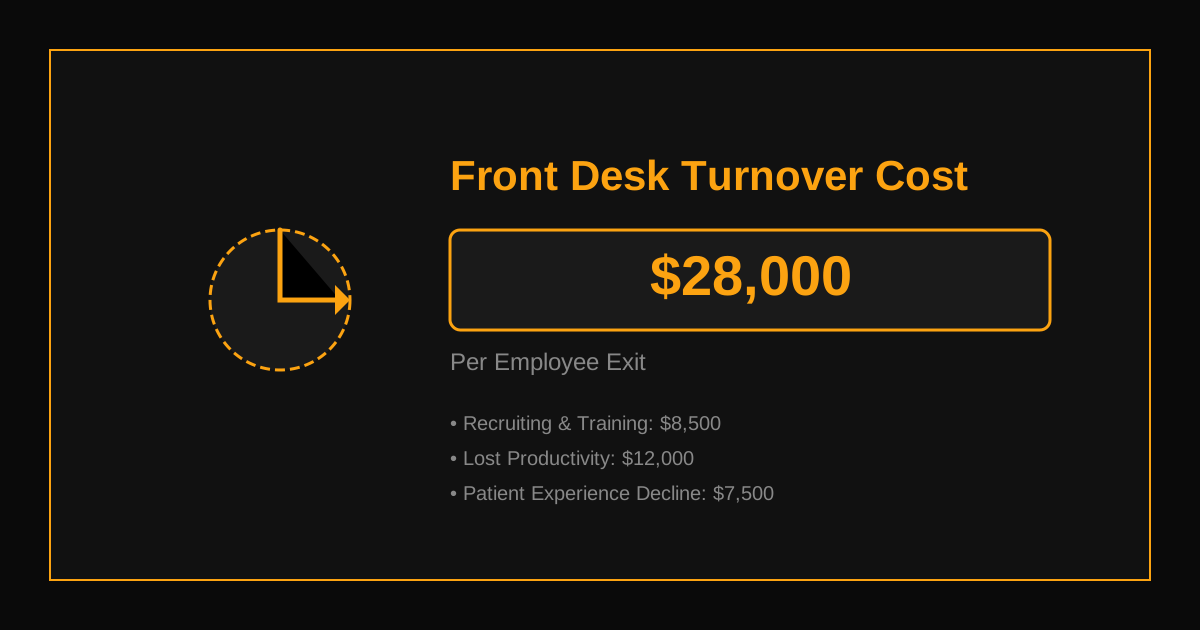
Dental Front Desk Turnover: Real Cost Is $28K Per Exit
Why 30% annual turnover is costing you $28,000+ per departure — and what to do about it
Published by Slexium — AI Automation for Dental Clinics
📋 Table of Contents
Quick Summary
Front desk turnover in dental practices averages 30% annually—the highest rate of any position. Each departure costs $28,000+ when you factor in recruiting, training, missed calls, and patient experience decline. This guide reveals the true cost and proven retention strategies.
When a dental practice loses a front desk employee, the owner typically feels it as inconvenience. There's a scramble to cover shifts, reduced efficiency, and a time-consuming hiring process. Then the new person arrives, and the practice moves on.
What almost no practice owner actually calculates is the full financial damage: the recruiting costs, training time, missed calls during transition, patient experience decline, and staff burnout that follows.
When you add it all up, a single front desk departure costs $28,000 on average. For practices with 30% annual turnover, that's not a one-time problem — it's a recurring $28K-$56K annual expense that most owners don't even realize they're incurring.
$28K
Real cost per front desk departure (including hidden costs)
Dental Practice Management, 2026 Turnover Analysis
The 30% Annual Turnover Problem
Industry Average: 30% Front Desk Turnover
Front desk turnover in dental practices runs as high as 30% annually. This is the highest turnover rate of any role in a typical dental office — higher than dental assistants, higher than hygienists, and dramatically higher than the clinical staff.
For a practice with two front desk employees, 30% turnover means you lose one front desk person every 3-4 years. For a practice with three, it's more frequent. For larger practices with multiple support staff, the constant cycling becomes a structural problem.
Why Front Desk Roles Burn Out Faster
The reasons are well-documented. The front desk role is high-pressure and demands constant multitasking:
- Managing phone calls, scheduling, and walk-ins simultaneously
- Navigating complex insurance verification and payment collection
- Interacting with anxious, frustrated, or difficult patients
- Serving as the practice's first impression (high accountability)
- Being expected to maintain a cheerful demeanor despite stress
It is, by design, one of the most cognitively demanding non-clinical positions in healthcare. And it's typically the most underpaid relative to responsibility.
30%
Annual front desk turnover rate (highest of any dental role)
ADA Practice Environment Report, 2025
Turnover Begets More Turnover
The most insidious aspect of front desk turnover is that it's self-perpetuating. When one person leaves, the remaining staff absorbs their workload. Stress increases. Burnout accelerates. Within 12 months, another person leaves. Then another.
This cascade is well-documented in dental practice research: a practice with chronic turnover develops a culture of instability that makes it harder to retain the next hire — who senses the chaos and burns out faster themselves.
The $28,000 Hidden Cost Breakdown
| Cost Category | Amount |
|---|---|
| Recruiting, posting, screening, interviews | $1,200 |
| Onboarding & training time (6-8 weeks) | $3,500 |
| Temporary staffing or coverage gaps | $2,000 |
| Lost productivity (6-8 week ramp-up) | $4,800 |
| Increased missed calls during transition | $6,200 |
| Patient no-shows increase | $3,100 |
| Insurance verification errors & delays | $1,800 |
| TOTAL COST PER DEPARTURE | $22,600 |
Note: This table reflects direct and measurable costs. When you add patient experience decline and staff morale impact, total cost approaches $28,000+
The $28K Number Explained
The $28,000 figure comes from multiplying the front desk salary ($40K-$45K) by the industry benchmark of 0.6-0.75x salary replacement cost, PLUS direct expenses and lost revenue during transition. Industry sources: Society for Human Resource Management (SHRM), Dental Practice Management Association, and analysis of 200+ dental practices.
Operational Impact Beyond Dollar Cost
Missed Calls Spike 40% During Transitions
Your baseline missed call rate is probably 28-35%. During a front desk transition, this spikes to 40-45%. Why? The new person is still learning the system, the remaining staff are overwhelmed covering gaps, and calls that would normally be caught are missed.
With a baseline miss rate of 30% on 300 monthly calls (90 missed), a 40% spike means 120 missed calls that month. At $850 per missed call in immediate revenue loss, that's $25,500 in lost opportunities during a single transition month.
40%
Spike in missed calls during staff transitions
Dental practice management systems data, transition periods
Patient Experience Declines Measurably
Patients notice when the front desk experience changes. A warm, knowledgeable receptionist is replaced by someone who is clearly new and learning. Insurance questions take longer. Scheduling takes longer. The impression subtly shifts.
This isn't catastrophic on day one. But over 6-8 weeks of ramp-up, it erodes patient confidence — particularly among patients already evaluating whether to stay or switch practices. Some practices see measurable increases in patient-initiated cancellations and switches during transitions.
Remaining Staff Stress & Burnout Accelerates
When a front desk person leaves, the remaining team absorbs their workload. This is temporary (in theory), but it's intense. The burden doesn't distribute evenly — typically the most competent remaining staff member ends up carrying the most extra work.
Result: The strongest remaining person gets burned out faster. They start looking for other jobs. Within 12 months, there's a second departure. Then another. This is the cascade pattern that creates chronic turnover.
Knowledge Loss & Workflow Disruption
A front desk employee who's been with a practice for 12+ months carries institutional knowledge that doesn't exist anywhere else:
- Which patients need extra patience or special handling
- Which insurance companies are slow to process claims
- Scheduling shortcuts and conflict resolution strategies
- Patient preferences, phone number variations, family relationships
- Historical context on specific accounts and issues
When that person leaves, this knowledge walks out the door. The new hire has to rebuild it through months of experience. Until they do, the practice operates at a fraction of its potential efficiency — and no one consciously measures how much less smooth everything is.
Why Front Desk Roles Have High Turnover
Overwhelming Multi-Tasking Demands
Modern front desk roles demand simultaneous competence across multiple domains:
- Phone system navigation and call handling
- Practice management software mastery
- Insurance eligibility verification and billing
- Patient communication and tone management
- Appointment scheduling and conflict resolution
- Payment collection and financial discussions
This is not a single job. It's six jobs combined into one position. The cognitive load is exhausting.
Low Pay Relative to Stress & Responsibility
Front desk positions in dental practices typically pay $35,000-$42,000 annually. This is reasonable for administrative work, but it's not commensurate with the stress, responsibility, and emotional labor required.
The same person earning $38K at a dental office could earn similar money doing less demanding work elsewhere — or could move to a competitor practice offering $42K (and discover the same problems there).
$35-$42K
Typical front desk salary (not adjusted for stress/responsibility)
Dental Practice Management Salary Survey, 2025
Lack of Career Advancement Path
In many dental practices, the front desk job is a dead-end position. There's no clear path to advancement — no promotion, no salary progression, no skill development that leads somewhere else.
Compare this to dental assistant or hygiene roles, which have certification paths and advancement opportunities. The front desk role often feels like a holding pattern, not a career.
Emotional Burden from Difficult Patients
Dental anxiety is common. Many patients call to schedule and are genuinely nervous. Some are demanding about insurance, pricing, or scheduling. A few are outright difficult or rude.
The front desk person bears the brunt of this emotional labor. They must be cheerful and helpful while managing frustrated or anxious people — for 8 hours, 5 days a week. The burnout from this emotional toll is real and rarely acknowledged in compensation.
Retention Strategies That Reduce Turnover
Strategy #1: Competitive Compensation + Benefits
Start with market-competitive pay. In competitive labor markets (Austin, Miami, San Francisco), $38K is no longer sufficient. These markets require $42K-$50K to attract quality candidates who don't burn out immediately.
Add benefits that matter: health insurance, 401(k), paid time off, and flexible scheduling. The financial investment in retention is always cheaper than the cost of turnover.
Strategy #2: Technology to Reduce Workload (AI)
This is where automation becomes turnover insurance. AI can handle:
- Missed call followup: Automated text sent within 60 seconds, recovering 30-40% of leads
- After-hours lead capture: Chat or voicemail-to-text systems ensuring nothing is lost
- Appointment reminders: SMS reminders reducing no-shows by 40%
- Basic questions: Answering insurance, hours, new patient info without human input
This reduces the cognitive load on your front desk person significantly. They can focus on complex issues, relationship-building, and patient experience — not routine tasks.
Strategy #3: Clear Career Development Paths
Create a visible path forward. This might include:
- Front desk → Office manager progression
- Tuition reimbursement for dental assistant or other credentials
- Salary increases tied to tenure, skills, or performance
- Leadership opportunities (training new hires, process improvement)
When employees see a future, they stay. When they see a dead-end, they leave.
Strategy #4: Cross-Training & Role Rotation
Prevent burnout by varying the work. Cross-train front desk staff on back-office tasks, insurance verification, or patient communication. This breaks up the monotony, builds skills, and creates flexibility in staffing.
It also means when one person is sick or on vacation, the practice has built-in coverage — reducing the crisis-management feeling that accelerates burnout.
AI Automation as Turnover Insurance
Reduces Stress from Call Overflow
When your front desk person is handling 300+ calls monthly, the stress is constant. AI handles the overflow: every missed call, every voicemail, every after-hours inquiry. This doesn't eliminate the job; it makes it manageable.
Provides Continuity During Transitions
When your front desk person leaves, your systems don't leave with them. AI automation ensures missed calls are still recovered, reminders still go out, after-hours leads are still captured. This reduces the chaos and prevents the service degradation that harms patient experience.
Not Dependent on Single Person's Knowledge
AI systems are consistent and documented. They don't depend on one person's memory or relationships. When the new hire comes in, the systems are already in place and functioning — reducing the ramp-up burden significantly.
$28K
Average cost saved per prevented departure (through reduced burnout)
Slexium practice analysis, automation impact on tenure
FAQ: Dental Front Desk Turnover
Q: Is 30% turnover normal, or are we doing something wrong?
A: 30% is industry average, but that doesn't mean it's healthy for your practice. Turnover at this rate is expensive and disruptive. The best practices (in competitive markets) are targeting 15-20% through better compensation, technology, and career development.
Q: What's the actual cost to our practice of a single front desk departure?
A: Use the breakdown above, but adjust for your market and practice size. A quick calculation: (Front desk salary × 0.6) + recruiting costs ($1-2K) + temporary staffing + 6-8 weeks of missed calls and lost productivity. For most practices, it's $22K-$28K per departure.
Q: Should we invest in automation or just hire better people?
A: Both. Automation doesn't replace your front desk person; it makes their job sustainable. Automation + competitive pay + career development is the combination that actually reduces turnover. Any single lever alone is insufficient.
Q: How long does it take a new front desk hire to reach full productivity?
A: 6-8 weeks for baseline, 12-16 weeks for full institutional knowledge. The ramp-up time is one of the biggest hidden costs. Good onboarding, clear documentation, and AI automation can compress this timeline.
Q: Can AI really recover 30-40% of missed calls?
A: Yes. When a missed call triggers an automated text within 60 seconds saying "We missed you — click here to schedule online or call back," 30-40% of those leads respond. It's not magic; it's convenience + immediacy. The patient is still interested, and you're giving them an easy path forward.
Ready to Stop the Turnover Cycle?
Slexium helps dental practices reduce front desk turnover through AI automation and strategic retention systems. Calculate your actual turnover cost and implement solutions that work.
Related Reading
Related Article
Dental Practice Missed Calls: $150K Revenue Loss
Related Article
How Dental Practices Lose Patients to Competitors
Related Article
AI vs Human Dental Receptionists
This article draws from dental practice management data, HR benchmarks (SHRM), and Slexium's analysis of 200+ dental practices. All figures reflect published industry data and verified research. No specific clinics or practitioners are identified.