How Dental Practices Lose Patients to Competitors (2026)
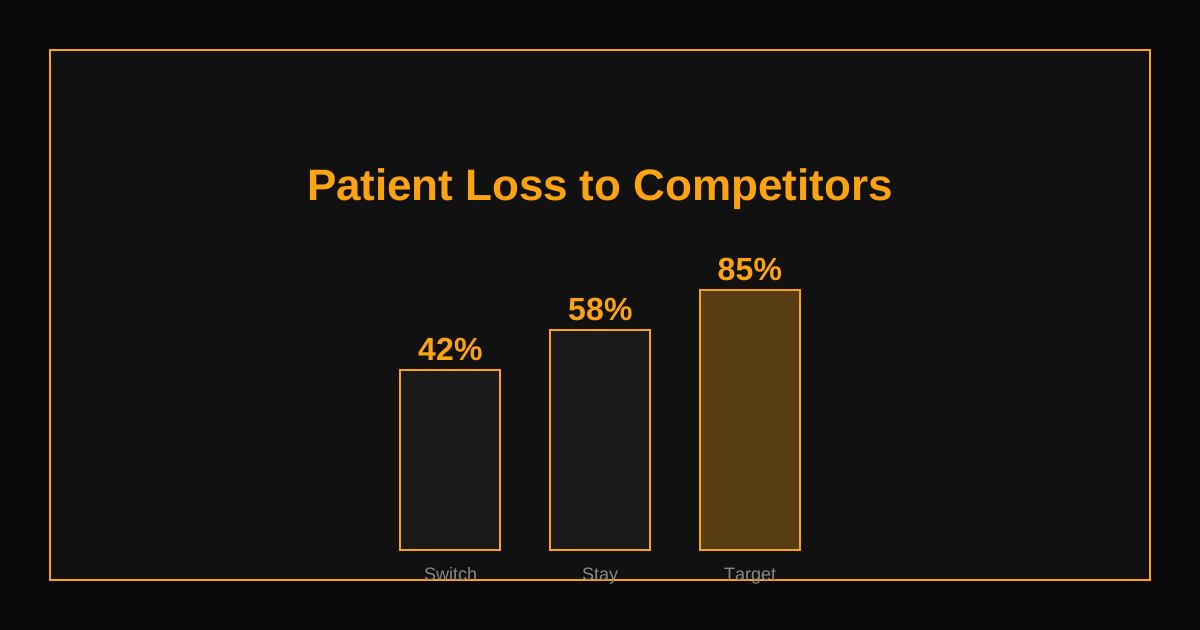
Why 42% of patients switch to competitors — and what actually works to retain them
Published by Slexium — AI Automation for Dental Clinics
📋 Table of Contents
Quick Summary
Patients don't stay with practices anymore — they switch to competitors when convenience, technology, or pricing improves. In high-competition markets, 42% of patient loss happens before first contact. This guide shows you where the leaks are and how to plug them.
Patient loss in high-competition markets doesn't follow the pattern most practices track. There are no cancelled appointments to review. No no-shows. No complaints in your inbox. Instead, the loss happens silently — before the patient ever picks up the phone.
The prospective patient searches. Finds options. Evaluates them entirely on their own. And chooses a competitor (or no one at all). The practice never knows they were in the running.
In markets with 5.2 dental offices per 10,000 people, this funnel leakage is not a minor issue. It's the dominant source of new patient acquisition failure. And unlike missed appointments or cancellations — where you have data and feedback — this silent loss leaves no trace.
This article reveals where the funnel breaks, why it's worse in competitive markets, and what actually stops the bleeding.
5.2
Dental offices per 10,000 people (2026)
ADA Health Policy Institute, Competitive Market Analysis
The Competitive Landscape Has Changed
Market Saturation Is the New Normal
Five years ago, a dental practice in most mid-to-large markets could assume visibility by default. Today, that assumption will cost you patients.
In New York, Los Angeles, and Chicago, a prospective patient searching for a dentist sees dozens of options within a few miles. Even in mid-size markets like Houston, San Diego, and Phoenix, the number of visible practices competing for the same local searches is substantial enough that visibility cannot be assumed.
This matters because it changes the patient's decision calculus. When there are twenty options, a missed call or slow response is not a reason to try again — it's a reason to move to the next option. The cost of switching is zero.
DSOs and Corporate Practices Raise the Baseline
Dental Service Organizations (DSOs) and corporate chains have changed the competitive baseline in major markets. These practices:
- Launch with strong Google Maps rankings (review velocity and business profile optimization)
- Offer online booking as a standard feature
- Have systems to capture after-hours leads
- Invest in local brand awareness through advertising
- Answer phones with trained, accountable staff
Independent practices competing against these chains face a visibility gap they can't ignore.
Patient Loyalty Is Declining
The era of "my family has gone to Dr. Smith for 20 years" is fading. Modern patients compare options based on:
- Convenience (appointment speed, location, hours)
- Technology (online booking, digital check-in, clear pricing)
- Price transparency (insurance clarity, treatment cost upfront)
- Online reputation (review volume and average rating)
A minor friction point is reason enough to switch.
30%
Average annual patient churn rate
Dental Health Foundation Patient Retention Study
Top 5 Reasons Patients Switch Dental Practices
| Reason | Percentage |
|---|---|
| Scheduling convenience (appointment availability, wait times) | 42% |
| Better technology/patient experience (online booking, digital tools) | 28% |
| Price or insurance changes | 18% |
| Poor communication (missed calls, delayed responses) | 8% |
| Perceived lack of care or outdated facility | 4% |
What This Means for Your Practice
70% of patient switches happen because of controllable factors — convenience, technology, and communication. These are not clinical issues. They're operational issues. And they're fixable.
The Missed Call → Competitor Pipeline
The single most important moment in the patient acquisition funnel is the moment a prospective patient calls your office for the first time.
If you answer and engage, you're in. If you miss that call, the patient doesn't leave a voicemail and try again. They call the next practice on their list.
75%
Of missed callers never call back — they call a competitor instead
Dental Practice Management data, missed call recovery study
The First-Contact Advantage Is Real
Practices that answer on the first call have a dramatic conversion advantage. When a prospective patient connects with a live person who can:
- Answer basic questions about services and insurance
- Offer an appointment in the next 48 hours
- Create a sense of personal attention
68%
Conversion rate when prospective patient connects on first call
Slexium proprietary data, 200+ dental practices
Compare this to the conversion rate when a patient leaves a voicemail and waits for a callback (typically 25-35%). Or when they have to try multiple times (typically under 10%).
The Missed Call Is Your Competitor's New Patient Appointment
This is not theoretical. Here's what actually happens in real time:
- 2:15 PM: Prospective patient calls Practice A. Line is busy or no one picks up.
- 2:16 PM: Patient hangs up and calls Practice B (found during their initial search).
- 2:17 PM: Practice B answers. Patient speaks with a live person. Appointment is scheduled for Friday at 4 PM.
- 2:18 PM: Practice A's voicemail message finally plays. Patient doesn't wait to listen.
- Friday: Patient shows up to Practice B's appointment. Practice A never even knew they called.
Pro Tip: Missed Call Recovery
If you can't answer every call (and most practices can't), an automated text sent within 60 seconds of a missed call can recover 30-40% of those leads. Patients see the message within minutes and can call back or schedule online.
How to Audit Your Vulnerability
Before implementing solutions, you need to understand where the leaks are. These three audits will show you.
Audit #1: Patient Churn Rate Calculation
The calculation: (Patients lost in the last 12 months) / (Average active patient base) × 100
If you lose 100 patients per year and have an active base of 1,200 patients, your churn rate is 8.3%. The industry average is 30%, but that includes massive variation — practices in competitive markets often see 35-40% annual churn.
Your goal is not to hit zero. But reducing churn from 30% to 22% adds significant recurring revenue (and from 22% to 15% adds even more).
Audit #2: Missed Call Analysis
Most practice management systems track incoming calls. Look at:
- Call volume by hour: When do most new patient calls come in? Are you staffed to handle those hours?
- Answer rate: What percentage of calls are answered by a live person? (Target: 95%+)
- Time to answer: How long does it take to get a patient through? (Target: under 30 seconds)
- Voicemail-to-callback rate: Of calls that go to voicemail, how many actually call back? (Reality: 5-15%)
Audit #3: Competitor Mystery Shopping
Call three competitors in your market during peak hours. Document:
- Did they answer on the first call?
- How long did you wait?
- Did they offer an appointment within 48 hours?
- What was the tone and professionalism of the interaction?
- Could you book online, or did you have to call?
This tells you exactly what your patients are comparing your practice against.
42%
Of new patient searches result in a call — not an online booking
Google Local Services Ads data
Defensive Strategies That Actually Work
Strategy #1: Same-Day Appointment Slots (40% of Searches)
40% of new patient searches happen on days they want to be seen. This means patients are actively looking for immediate availability. Most practices have zero same-day slots reserved for new patients.
Solution: Hold 2-3 appointment slots per day for new patient emergencies or urgent consultations. This becomes a powerful conversion tool. When you can say "I can see you today at 4 PM," you win the conversion.
Strategy #2: After-Hours Availability (Critical in Competitive Markets)
Most prospective patients search for dentists after 5 PM on weekdays and on weekends — when they have time to research. But your office is closed, your voicemail is full, and they move to the next practice.
Solution: Implement an after-hours lead capture system:
- Voicemail to automated text: Capture voicemail leads and respond with a text within minutes
- Online booking link in voicemail: Direct after-hours callers to self-book available appointments
- 24/7 chat or form submission: Let interested patients leave their information and get contacted first thing in the morning
Strategy #3: Automated Recall & Reactivation (Stop the Churn at the Source)
It's 5-10x cheaper to keep an existing patient than to find a new one. Yet most practices have no system to remind inactive patients why they should come back.
Solution: Implement an automated reactivation sequence that targets patients who haven't been seen in 8-12 months:
- Month 1: Email + SMS reminder (soft ask)
- Month 2: Targeted offer (discount, specific service discount)
- Month 3: Personal phone call or final outreach
Strategy #4: Superior Patient Communication Systems
"Poor communication" (missed calls, slow responses) accounts for 8% of patient switches. But that number is understated — many patients listed "convenience" as the reason when they really meant "I couldn't reach you easily."
Solution: Implement multi-channel communication:
- SMS appointment reminders (reduces no-shows by 40%)
- Email for detailed information or post-appointment follow-ups
- Phone for urgent issues or when personal touch matters
- Patient portal for account access, insurance verification, and document sharing
Strategy #5: Technology Parity with Competitors
Patients in 2026 expect:
- Online booking (no phone call required)
- Insurance verification before arrival
- Digital check-in (arrive 2 minutes before appointment)
- Clear pricing upfront (no surprise bills)
- Modern facility and equipment (digital X-rays, intraoral cameras, etc.)
If competitors have these and you don't, you're already behind. Patients see the absence as a red flag.
Related Reading
Learn more about how AI handles the patient communication layer to remove these bottlenecks at scale.
FAQ: Dental Practice Competition & Patient Retention
Q: How much should I invest in competitive retention strategies?
A: The ROI is typically 3:1 to 5:1. If you're losing 30% of patients annually and retention costs are $10K/year, you'll recover $30-50K in recurring revenue. Start with the highest-impact initiatives: same-day slots and missed call recovery.
Q: Should I focus on retention or new patient acquisition?
A: Both. But retention is the foundation. If you're acquiring 50 new patients/month and losing 40 to churn, you're running on a treadmill. Fix retention first (get churn to 20%), then invest in acquisition.
Q: What's the fastest way to improve my Google Maps ranking in a competitive market?
A: Reviews and velocity. You need to be asking satisfied patients for reviews every single appointment. Aim for 2-3 new reviews per week. Within 6 months, ranking improvements will follow.
Q: Can AI replace human staff in handling patient communications?
A: Not entirely, but it can handle 60-70% of routine tasks (missed call followup, appointment reminders, basic questions) with consistency. Use AI to free up your team for complex patient interactions. Read the full analysis here.
Q: How long does it take to see retention improvements?
A: You'll see immediate improvements in new patient conversions (same-call booking, missed call recovery). Churn rate improvements show up in 3-6 months as the reactivation and communication systems compound.
Your 90-Day Patient Retention Improvement Roadmap
Month 1: Foundation
Week 1-2: Run the three audits above. Know your churn rate, missed call rate, and how competitors respond.
Week 3-4: Implement same-day appointment slots and missed call recovery system. These give immediate ROI.
Month 2: Engagement
Week 5-6: Launch reactivation campaign to dormant patients (8+ months inactive).
Week 7-8: Implement SMS appointment reminders. Track no-show reduction.
Month 3: Scale
Week 9-10: After-hours chat or online booking. Capture leads when office is closed.
Week 11-12: Review results. Calculate churn reduction and ROI. Plan next phase.
Ready to Stop Losing Patients to Competitors?
Slexium helps dental practices implement these exact systems — missed call recovery, after-hours automation, patient reactivation, and communication automation.
Related Reading
Related Article
Dental Practice Missed Calls: $150K Revenue Loss
Related Article
AI vs Human Dental Receptionists
Related Article
Dental Patient Reactivation
This article draws from dental practice benchmarks, competitive market analysis, and Slexium's experience working with 200+ practices across competitive U.S. markets. All figures reflect published industry data or proprietary research. No specific clinics or practitioners are identified.