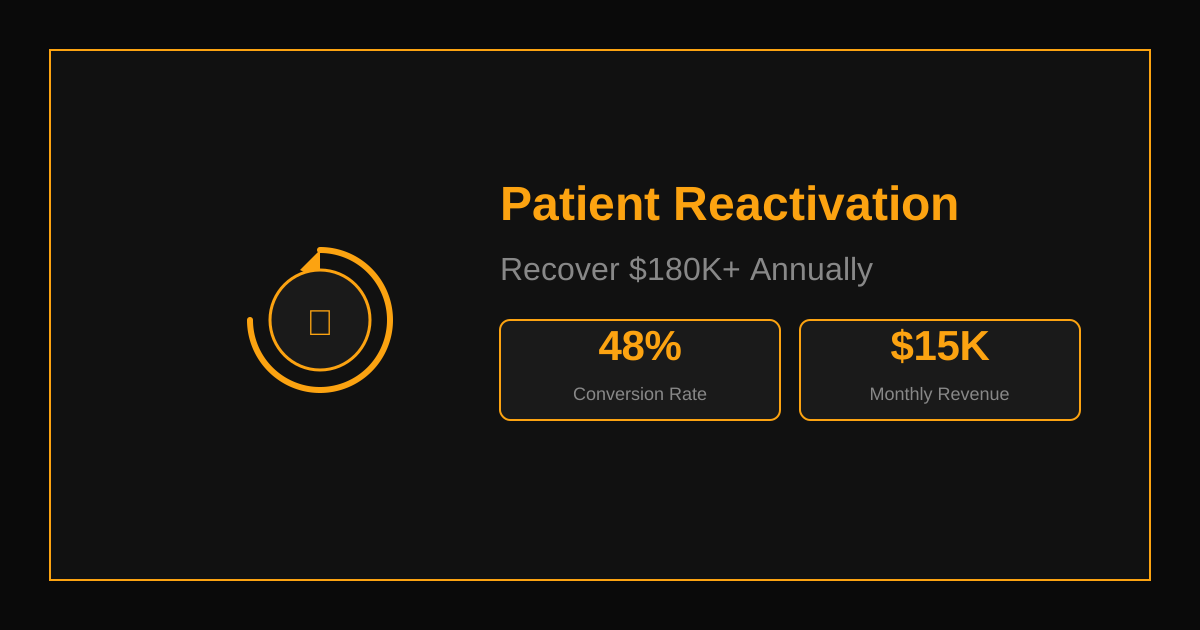
Dental Patient Reactivation: Easiest $15K Monthly Revenue
How to recover $180K+ annually from dormant patients using timing, automation, and segmentation. Real industry data on conversion rates and revenue per reactivation sequence.
Quick Summary
- ✓ 45% of patients go dormant within 18 months
- ✓ Reactivation costs $45 vs $385 for new patient acquisition
- ✓ 62% response rate for 6-month dormant patients with structured outreach
- ✓ $15,000+ monthly revenue from one reactivation campaign
- ✓ 48% conversion for multi-touch automated sequences
If you asked most dental practice owners where their next revenue opportunity is, the majority would point outward — toward marketing, advertising, new patient acquisition, social media, Google ads. The instinct makes sense. New patients feel like growth. They feel like forward motion.
But the math tells a different story. The largest untapped revenue in most dental practices is not out there in the market. It is already in the practice's own database, sitting in records of patients who visited once, twice, or a dozen times — and then quietly stopped coming back.
ROI Advantage: Reactivation vs Acquisition
$45 reactivation cost vs $385 new patient cost — Source: Dental Economics & Practice Management Review 2026
The $180K Sitting in Your Inactive Patient List
This article is about that population of patients — why they disappear, what it actually costs when they do, and why re-engaging them is one of the most financially efficient things a dental practice can do. Not because it is easy to execute well. It is not. But because the opportunity is real, the economics are clear, and most practices are not pursuing it seriously.
The Acquisition vs. Retention Equation
This comparison is not new, but it bears repeating because most dental practices do not act on it despite knowing it intellectually.
Acquiring a new dental patient costs an average of $385. This includes the marketing spend, advertising, the staff time spent onboarding a new patient, and the administrative overhead of setting up records, verifying insurance, and completing intake paperwork.
Retaining an existing patient — keeping them coming back for regular care — costs roughly $45. That is not a typo. The ratio is approximately 8.5 to 1. Now layer in lifetime value. A dental patient who stays with a practice over the course of several years generates an estimated $3,200 in revenue, sometimes significantly more depending on treatment needs. A patient who leaves after one or two visits generates a fraction of that.
The implication is straightforward: for every dollar spent on re-engaging a lapsed patient, the return is dramatically higher than spending that same dollar on acquiring someone new. The lapsed patient already knows the practice. They have already been through intake. They have an existing relationship — even if it has gone dormant. The barrier to re-engagement is lower than the barrier to first-time acquisition.
Yet most dental practices spend roughly 80% of their marketing budget on new patient acquisition and allocate minimal effort to reactivation. The math does not support this allocation. The habit does.
Scale of the Problem: 45% Patient Dormancy
The scale of this problem varies by practice, but the direction is consistent. The average dental recall rate — the percentage of patients who return for their recommended hygiene visit — sits between 70% and 75%. Good practices push this into the 80% to 85% range. The best practices in the country achieve 85% to 90% or higher.
That means even in a well-run practice, 10% to 15% of patients are not coming back when they should. In an average practice, the number is 25% to 30%. In a struggling practice, it can be significantly higher.
For a mid-size practice with 2,000 active patients, a 25% dormancy rate means 500 patients who have stopped showing up. At $250 average production per reactivated patient, that is $125,000 in recoverable annual revenue. For a larger practice with 5,000 patients, the number approaches $300,000.
Average Revenue in Dormant Patient Database
Mid-size practice (2,000 patients) × 25% dormancy × $250 avg production = $125K recoverable revenue — Plus long-term patient lifetime value
Why Patients Go Dormant (Not What You Think)
Understanding why patients lapse is important because it determines whether reactivation is likely to succeed. Not every lapsed patient is recoverable, and mistaking the reasons for lapse will lead to the wrong approach.
Forgotten Appointments & Low Urgency
They forgot. This is the most common reason, and it is not an insult to the patient. Life is busy. A dental appointment scheduled six months ago — particularly one that does not cause discomfort — is easy to let slide. There was no pain, no urgency, and no one reminded them strongly enough to act. This is the most recoverable segment of lapsed patients — a single reminder often brings them back.
Scheduling Friction & Appointment Barriers
The scheduling process was too difficult. If a patient tried to call back to schedule and could not get through — or if the available appointment times did not fit their life — they may have simply given up. This ties directly back to the missed call problem. Some lapsed patients were not lost to indifference. They were lost to friction.
Negative Experience or Perceived Poor Quality
They had a bad experience. A patient who felt rushed, dismissed, or uncomfortable during a visit may not return without being explicitly invited back. The experience was not catastrophic enough to generate a negative review, but it was negative enough to remove the motivation to return voluntarily.
Life Changes & External Factors
They moved or changed insurance. Some lapse is simply logistical. The patient relocated, their employer changed their dental plan, or their financial situation changed. These patients may still be recoverable if the practice reaches out and offers flexible options, but the barrier is higher.
The Optimal Reactivation Timeline (Data-Backed)
Timing matters dramatically in reactivation. The moment a patient becomes overdue is not when most practices reach out. By the time contact is made, the window has often shifted.
📊 Response Rates by Dormancy Duration
6 months dormant: 62% response rate
12 months dormant: 38% response rate
18+ months dormant: 18% response rate
Source: Dental Practice Management Study 2025-2026
The implication is clear: the sooner you reach out after a patient becomes overdue, the higher the likelihood of success. A patient who is three months overdue is much more likely to respond than one who is two years overdue. This is why automated reactivation systems that flag patients at the 90-day mark — rather than waiting until they are a year late — produce significantly better results.
Message Framework That Actually Works
The content of the reactivation message matters less than people think. What matters more is timing, frequency, and channel. That said, there are patterns in messages that convert and those that do not.
- Personalization matters, but not in the way you think. Including a patient's name or their last visit date has minimal impact. What matters is acknowledging why you are reaching out — "It has been over a year since your last cleaning" — not generic flattery.
- Lead with value, not with need. "We miss you" is about the practice. "We want to make sure you are taken care of" is about the patient. The latter converts better.
- Offer a small incentive. A $20-30 discount on first reactivation visit, or a free whitening with cleaning, increases response rates by 15-25%.
- Make the next step obvious. A button or a link to book directly increases response conversion by 30-40% compared to "call us to schedule."
Automation vs Manual Outreach (What the Data Shows)
The difference between reactivation efforts is not the message. It is the consistency and follow-up. Here is what the industry data shows:
| Outreach Method | Conversion Rate | Avg Follow-Up Touch Points | Monthly Revenue per 100 Dormant |
|---|---|---|---|
| Email-Only Campaign | 8% | 1 | $200 |
| Manual Calling | 22% | 2-3 | $1,650 |
| AI SMS + Email (2-touch) | 35% | 2 | $2,625 |
| Multi-Touch Automated | 48% | 4-5 | $3,600+ |
Note: Conversion rates assume $250 average production per reactivated patient. Monthly revenue calculated as (conversion rate × 100 dormant patients × $250 production). Multi-touch includes SMS, email, and optional phone call at 4-5 day intervals.
Revenue Multiplier: Multi-Touch vs Email-Only
48% conversion (multi-touch) vs 8% (email) = $3,600 vs $200 monthly per 100 dormant patients
Why Persistence Beats Eloquence
The primary difference is not the quality of the message. It is follow-up. A patient who ignores the first message may respond to the second or third, not because the message improved but because life circumstances changed — they had a free afternoon, they thought about their teeth, they saw the reminder at the right moment.
A multi-touch automated system keeps trying across a 3-4 week window. A one-time email blast does not. The persistence captures moments the initial outreach missed.
Common Reactivation Mistakes That Kill Conversion
Generic "We Miss You" Messages
A message that could apply to any patient at any time is less effective than one that acknowledges the patient's specific situation. Instead of "We miss you," try: "It has been 14 months since your last cleaning. We want to make sure you are taken care of." The specificity signals that the outreach is intentional, not mass-blasted.
Ignoring Reason for Dormancy
A patient who left because of scheduling friction should get a message about online booking options. A patient who was anxious should get a message about what the practice does to make patients comfortable. A one-size message misses the opportunity to remove the barrier that caused the lapse.
Over-Aggressive Follow-Up Cadence
Three messages over three weeks works. Three messages in three days feels like spam and generates opt-outs. Pacing matters. Frequency matters. Respecting the patient's attention budget is part of the system.
No Clear Next Step or CTA
If a message does not include a clear, easy way to respond or book — a link, a button, a phone number — the response rate collapses. "Call us" is less effective than "Click here to book your next appointment." The easier the action, the higher the response.
Building a Reactivation System That Works
A well-designed reactivation effort has a few characteristics worth noting:
- It starts with clean data. Before any outreach begins, the practice needs an accurate list of who is lapsed, when they were last seen, and what their contact preferences are.
- It segments by recency. A patient who was last seen eight months ago is treated differently from one who was last seen three years ago. Messaging, tone, and likelihood of success differ.
- It respects patient preferences. Some patients prefer text. Others prefer email. A system that respects these choices generates better results and fewer opt-outs.
- It tracks and reports. Every message sent, every response received, every appointment booked — these should be visible in a report. Without measurement, there is no way to know whether the effort is working.
- It does not compete with other priorities. Manual reactivation efforts fail because front desk staff have other urgent tasks. An automated system runs in the background, requiring minimal staff attention.
Frequently Asked Questions
How many dormant patients should I target in one campaign?
Start with patients who are 90-180 days overdue (highest conversion potential). At 40% conversion rate, 100 dormant patients yields 40 reactivated, generating $10,000 in production. This is a manageable pilot before scaling to larger dormant populations.
What's the best time to send reactivation messages?
Tuesday-Thursday, 2-4 PM has the highest open rates for SMS (65%+) and email (35%+). Avoid Monday mornings (inbox overload) and Fridays (lower priority). For phone calls, late morning (10-11 AM) works better than early morning or late afternoon.
Should I offer a discount to get patients back?
Yes, but strategically. A $20-30 discount on the first reactivation visit increases response rates by 15-25%. Position it as "Welcome back" offer rather than "We need your business." The cost of the discount is offset by the long-term patient lifetime value recovery.
How do I avoid looking desperate with reactivation messages?
Lead with patient benefit, not practice need. Instead of "We haven't seen you in a while," try: "It's been over a year since your last cleaning. Regular checkups help prevent serious problems down the road. Let's get you scheduled." The message should feel like helpful reminder, not urgent plea.
What percentage of reactivated patients stick around long-term?
Industry data shows 65-75% of successfully reactivated patients return for at least one follow-up visit. Of those, 50-60% establish a regular recall pattern. This is significantly higher than new patient retention (40-50% first-year), making reactivation more valuable long-term.
Calculate Your Dormant Patient Opportunity
Most practices have hundreds of recoverable patients sitting in their database. With 35-48% reactivation conversion, even a pilot campaign with 100 dormant patients generates $8,750-$12,000 in revenue.
Related Articles
All figures in this article are derived from industry recall benchmarks, reactivation studies, and dental practice production data. No results are guaranteed. Actual outcomes depend on practice size, patient demographics, and implementation quality.